THE HISTORY OF CARDIFF'S SUBURBS
BUTETOWN AND CARDIFF BAY
Incorporating Tiger Bay and the Docks
CONTENTS
Tap or click to open / closeThe Building of the Docks
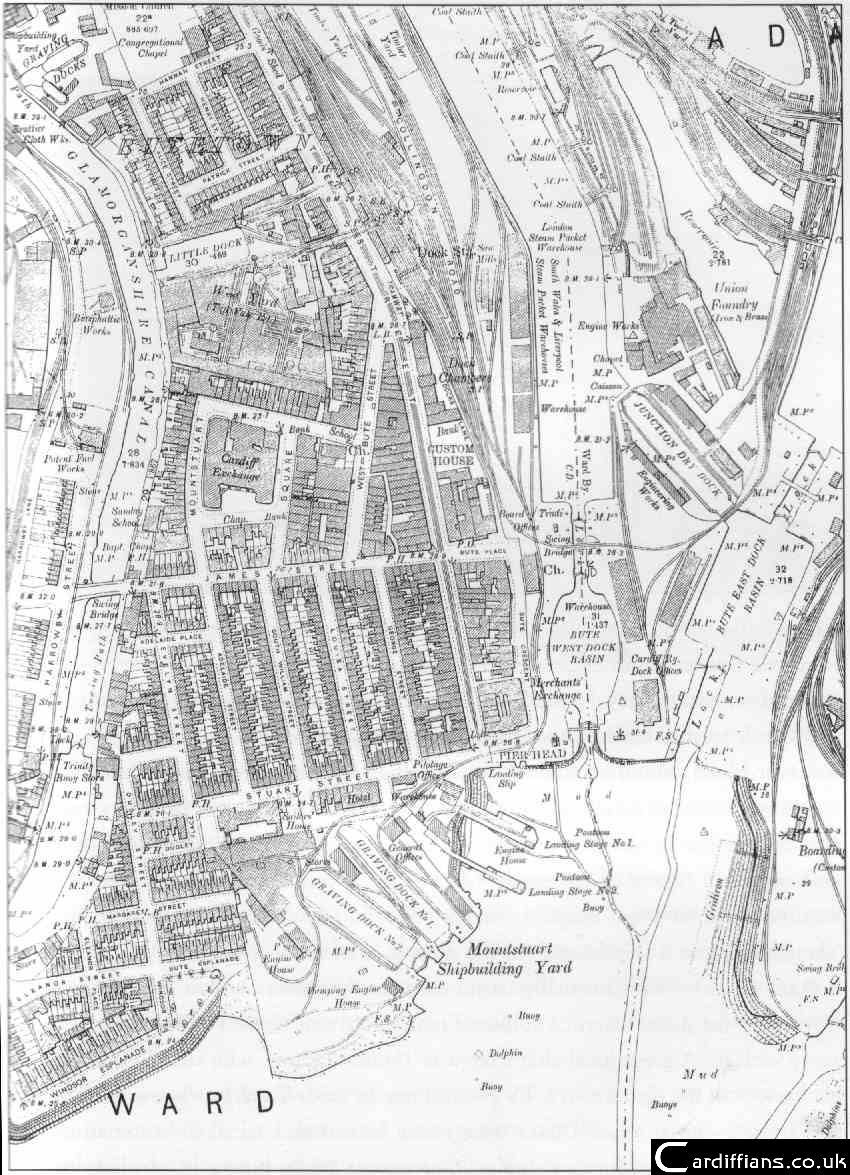
Source: OS
Butetown was barren moorland until the late 1800s, when the 2nd Marquis of Bute decided to build the first dock in Cardiff.
West Bute Dock opened in 1839 but unfortunately the Marquis, who passed away in 1848, never got to see how successful his business would be.
His infant son, John Crichton-Stuart, became the 3rd Marquis of Bute. John continued his father's dream of making Butetown a respectable, middle-class suburb.
The houses were mainly occupied by sea captains and merchants, with Ferry Road being particularly well known for its fine houses.
Offices with stunning architecture were built in Mount Stuart Square and Loudoun Square, for powerful people and companies.
The Coal Exchange was built in 1886 for Cardiff's leading businessmen, met to fix deals with countries all over the world.
In 1909, the first million-pound (£1,000,000) cheque was signed at the Exchange, and presented to the National Provincial Bank in Bute Street.
In 1912, St. Stephens Church (on the corner of Mount Stuart Square and West Bute Street) was consecrated. It was a replacement for a temporary iron church near the Pierhead building.
Contrasts in Community
The docks attracted many sailors looking to spend their wages on food, a keepsake for their wife or to indulge in some of the more seedy activities that Butetown offered!
Race Riots sometimes broke out, and the seamen's strike of 1911 was particularly vicious. Chinese laundries and lodging houses were set ablaze, while white people felt their living was under threat from 'blackleg' labour (people who would continue to work, rather than strike like their colleagues).
Unfortunately, during the decline of coal exports in the late 1930s, Butetown (which now had a unsustainable population) began to suffer from the effects of mass unemployment.

Source: BBC
It became dirty, noisy and crime levels were rising. As a result, the wealthier of it's inhabitants moved to the more reputable suburbs in Cardiff, and in their place arose a multi-ethnic community formed by people from all over the world.
Famous Faces from Tiger Bay
The docks acquired the nickname 'Tiger Bay' and Greek, Arab, Chinese, African, Irish and French people were just some of the many people you could find on Bute Road (now Bute Street) in a single hour!
Another person who was easily found on Bute Road, was Tommy Letton. A familiar face in the area, Tommy sold fresh fish in the street from his barrow, and soon became known as 'Uncle Tom'.
He was famous for being ever-ready to help other people and Letton Way is named after this friendly, hardworking man.
In 1937 Shirley Bassey was born at Adeline Street. By the time she was 20, Shirley was starring in shows in London, Paris, Monte Carlo and also sang three title songs for the 'Bond' films.
During World War Two, the docks' decline was prolonged for a short time, as three quarters of American supplies came through here during the build-up to the D-Day landings.
The Death of the Docks
Source: Unknown
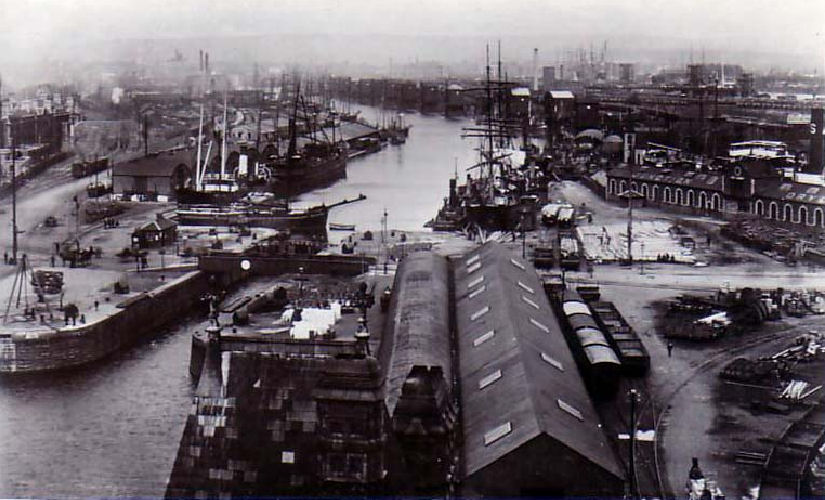
Coal finally ceased to be exported from the docks in 1964, and West Dock, the first dock in South Wales, closed.
The beautiful buildings quickly lost their powerful looks, and lapsed into decay with most of them being demolished. The film Tiger Bay, was shot mainly on location in 1959 and contains some of the final memories of that district.
The Norwegian Church was built in 1868 for the Scandinavian community near the West Dock and has close associations with Roald Dahl (he was Christened there) and his family.
It was located a mile from its current position, but by the 1970s it had been seriously vandalised and what parts could be saved were moved, piece by piece, to its new location in 1990.
A Regeneration of Epic Proportions!
At the end of the 20th century, the waterfront started to see a massive regeneration. In the 1980s, County Hall, the council headquarters, was established at Atlantic Wharf overlooking the partially filled in former East Dock.
The 1990s saw the building of the Cardiff Bay Barrage which when finished, would create a huge freshwater lake. Notices about the possibility of raised groundwater levels in the southern areas of the City were delivered to every household.
Nearly twenty years later, it seems that damage to homes was minimal. The initial worries are now feelings of pride in the quick and substantial progress in how it has rejuvenated the Bay, and property prices in particular.
Welsh Industrial and Maritime Museum

Source: Welsh Industrial and Maritime Museum
In 1977, the Welsh Industrial and Maritime Museum was constructed and opened on Bute Street, in a declining portion of Cardiff Docks.
The exhibits on the two floors of the Museum had been selected to illustrate how various industries in Wales, over a period of some 200 years, obtained power to drive a wide range of machines necessary for production.
Some of these massive exhibits included a Water Wheel, Beam Engine, Steam Engine and the largest in the gallery, the Ventilating Fan Engine.
External exhibits included a full scale working replica of Trevithick's Penydarren locomotive and the railway footbridge from Aberdare Station.
The museum was relocated to Swansea in 2003 and the building in the bay was demolished to make way for new developments.
Commercial and Political Development of the Bay
The Pier Head Building, built in 1896 and originally the home to the Bute Docks Company, was taken over by the Welsh Assembly in the late 1990s. In 1995 Techniquest had moved from the City Centre, to the UK's first purpose-built Science Centre in Stuart Street and has been entertaining people for nearly 25 years.
The Coal Exchange, which had for a number of decades been a venue for various events including boxing, concerts and award ceremonies, now stands closed and empty , awaiting essential repair work.
St. Stephen's church was sold to a private entertainment company in 2001. By 2003 it had undergone substantial renovation, and became a venue for live music performances.
In 2004, one of the original and very rare stained glass windows to the west of the church, were damaged by contractors working on converting the old bank next door, into a resturant.
The Millennium Centre was built in 2004, and is the new home for the Welsh National Opera. On 1st March 2006 (St. David's Day), Her Majesty Queen Elizabeth II arrived in a snow covered Cardiff to open the new debating chamber (The Senedd) for the Welsh Assembly.
There was public outrage over the cost of the new building, ultimately reaching £67 million.
Cardiff Bay in the 21st Century

© Matthew Witty
There is no doubt however, that the development and conversion of Tiger Bay into Cardiff Bay, has given a new lease of life to Butetown. The revived docklands have provided 20,000 jobs over the years, and many residential apartments have been built to take advantage of the stunning views.
Some of the more ill-concieved housing projects included the conversion of old business buildings in Mount Stuart Square and surrounding area. The new tenants soon started to complain about the music and general noise coming from The Point, and inevitably it was closed down in 2009.
Entertainment in the Bay was quickly replaced by the filming of 'Torchwood', the Doctor Who spin-off, which has its fictional base located directly underneath the Water Tower, whilst an episode of 'Doctor Who' saw the Bay being rocked by an earthquake! The National Provincial Bank was the main setting for the episode 'Blink', in which the Weeping Angels were introduced.
There are many choices for taking the family out for a meal - from a fry up in the local cafe, to fish and chips, or something a little more exotic. With the International Sports Village completed, the City of Cardiff now has one of the most attractive and cosmopolitan waterfronts in Europe - and it's all thanks to the Bute family's building of the docks.
In 2022, work started on the construction of a brand new line from Queen Street to Cardiff Bay Railway Station. It was built on the base of the old sidings which had been taken up and landscaped decades previously. It is fortunate that the land was never built on, which has likely made this upgrade a cost effective solution to increasing capacity on a local line to the ever popular Cardiff Bay.
.jpg "Pierhead at Cardiff Bay")
© Matthew Witty
- Mount Stuart Square - Peter Finch - Real Cardiff
- The Point - Wikipedia
- The Illustrated History of Cardiff's Suburbs - Dennis Morgan
- Welsh Industrial and Maritime Museum - Stuart Owen-Jones - 1984
PAGE UPDATE HISTORY
02 April 2024 (Coding and content updates)
30 December 2014 (Coding and content updates)
July 2009 (Page Created)