THE HISTORY OF CARDIFF'S SUBURBS
CANTON

Source: Unknown
CONTENTS
Tap or click to open / closeSt. Canna of Brittany
The name Canton may be derived from the nearby Canna brook in Pontcanna (named after St. Canna), and the word 'Ton', which can either mean Farm or Meadow. The name could also possibly have meant 'St. Canna's estate'.
Most historical sources indicate that Canton probably started life as a hamlet (a group of houses smaller than a village) before the Norman invasion.
St. Canna was a princess and part of the Breton Royal Family who had fled to Britain from Brittany (a Dutch named town in France) to escape the Roman invasions in the 4th Century. Canna used to sing to Pagan travellers passing by the bridge at Pontcanna, enticing them to the church to try and convert them to Christianity.
19th Century Developments
The area was sparsely populated but the Bishop of Llandaff, who owned the land, also owned a mill and a manor house.
In 1859, the Cattle Market and Slaughterhouse opened, and by the late 19th Century, there were stables, a meat market, and Fairs were being held monthly.
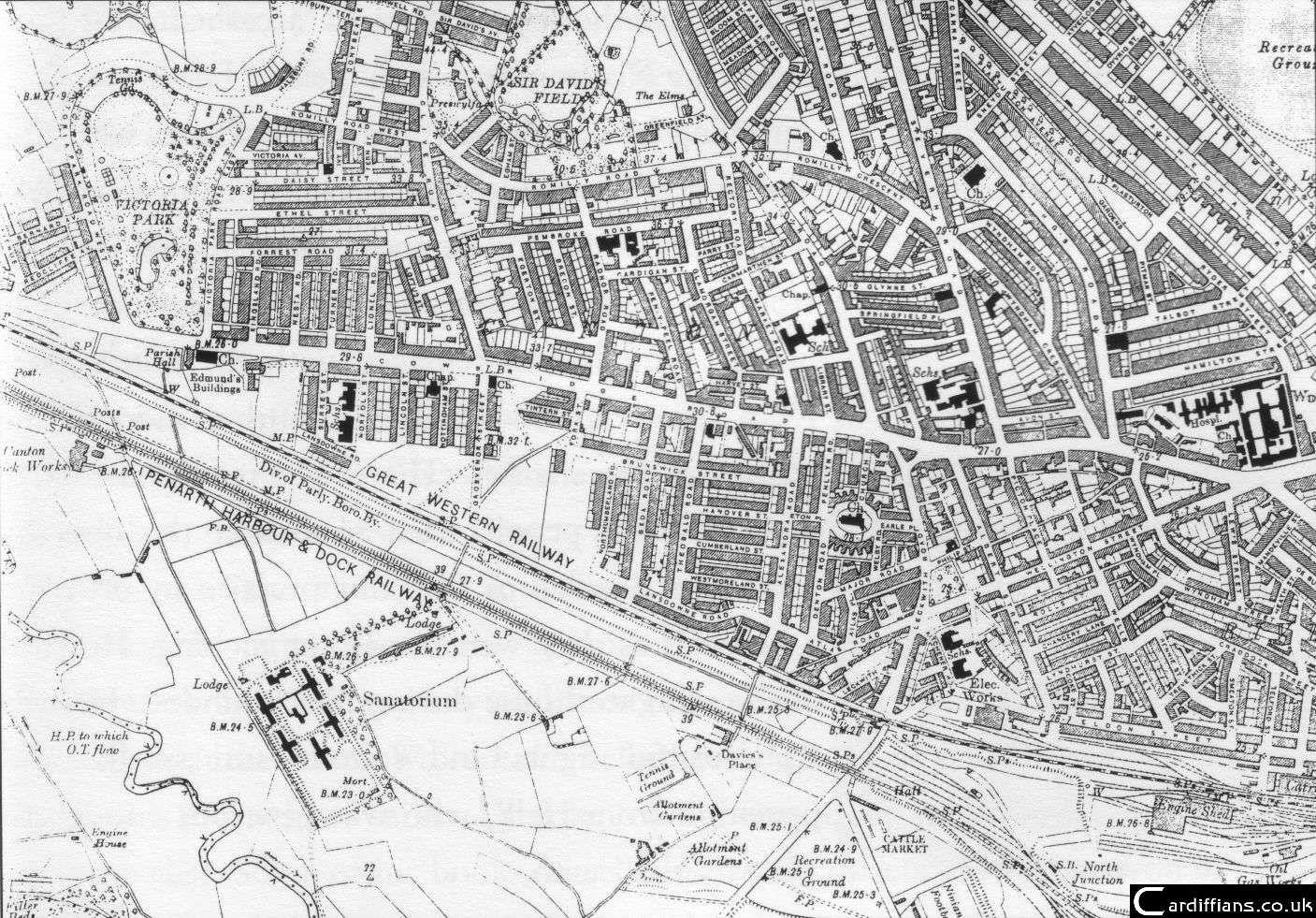
Source: OS
A major employer in the area was William Vaughan, a local councillor and preacher, who set up his laundry and dry cleaning business in 1860.
People from all parts of Cardiff brought their laundry and their clothing to be cleaned and pressed at the premises in Llandaff Road, until the business closed in the late 1960s.
The church of St John was built in 1871 and the spire is the only structure in Canton which stands out for miles around. One of its chapels is dedicated to St. Canna.
Canton merged with the borough of Cardiff in 1875 and in 1882, the first board school to be opened in the district was in Severn Road.
In 1885 the Cartwright family sold Ely & Canton Commons to the council, with Canton Common providing a home for Riverside Football Club fifteen years later.
The club became Cardiff City Football Club (CCFC / Bluebirds) three years after Cardiff itself became a City in 1905.
Two years later the club moved to their new stadium at Ninian Park in Sloper Road, on the site of a former landfill site purchased from the Bute Family.
Victoria Park and Billy the Seal
Victoria Park, known for its beautiful fountain and attractive flowerbeds, was opened in 1897 on the former Ely Common.
It had the first public bowling green in Cardiff, and was home to Billy the seal - an unusual neighbour but a famous Cardiffian nevertheless!

It is thought that she had been accidentally caught by a foreign trawler in 1912. When the ship arrived at one of the Bute Docks she was permanently moved to the lake at Victoria Park.
During her life in Canton, the public loved playing with her and feeding her - everyone actually though Billy was a male seal until her death in 1939.
During the first World War, he local authority considered Billy to be just as important as any other person, and was given half rations.
There is a well-known story about Billy being swept down Cowbridge Road during the Taff River flood of 1927. According to Frank Hennessy's song, during the flood Billy boarded a tram along Cowbridge Road and called in a pub for 'a half of dark'.
Parks and Arts
The original Canton High School was opened in 1907 on Market Road, but was nearly completely destroyed by the Luftwaffe during the German bombing raids in the second World War.
The school was repaired, but it soon moved to new premises at Fairwater in 1963. The building in Market Road is now the home of the 'Chapter Arts Centre'.
In 1891, land-owner Charles Thompson constructed a large garden for his home near Penhill. He donated the garden (Thompson's Park) to the City in 1911.
The upper level of the park is a large playing field which leads down through flower gardens and past a pool adorned with Swans, Ducks and Frogs.
There is also a small fountain with a statue of a young boy in the middle. An Aviary was also in the park up until its removal in the 1960's.
Cowbridge Road
Many family businesses started in Cowbridge Road, with some trading for nearly one hundred years. Franklin's Bakery at the corner of Gray Street and Pope's photography services, on the corner of Albert Street were some of the oldest shops that have unfortunately closed down in recent years. Woolworths, a victim of the credit crunch, closed in 2009 and became a charity shop.
The Coliseum and the Canton were popular cinemas in Canton before their closure in the early 1960s. Although Canton has not seen that much development since the 1960's and 1970's, the area is still renowned for it's busy yet friendly atmosphere.
Canton has beautiful Victorian housing, wide roads with plenty of parking, and a wide range of shops that offer everything you could ever need.
The night life in Canton can be a bit noisy due to the concentration of pubs on Cowbridge Road. One particular pub to note is the Robin Hood (on Severn Road) which was built in 1901, and owned by Charlotte Church's parents - this is where she started her career in singing.
PAGE UPDATE HISTORY
31 March 2024 (Coding and content updates)
01 December 2014 (Page updated in advance of site rebuild and new design launch)
July 2009 (Page Created)