THE HISTORY OF CARDIFF'S SUBURBS
LLANRUMNEY
CONTENTS
Tap or click to open / closeThe Church by the Rhymney River
The name Llanrumney comes from the Welsh word Llan, meaning "Church" or "Parish", and Rumney the Anglicised version of Rhymney (the local river with the same name).
After the Norman Conquest of Britain in 1066, the lands of Llanrumney were given to the monks at Keynsham Abbey, which was based just across the Severn in Somerset.
The monks built a small chapel where Llanrumney Hall, a Grade 1 listed building built in 1450, now stands.
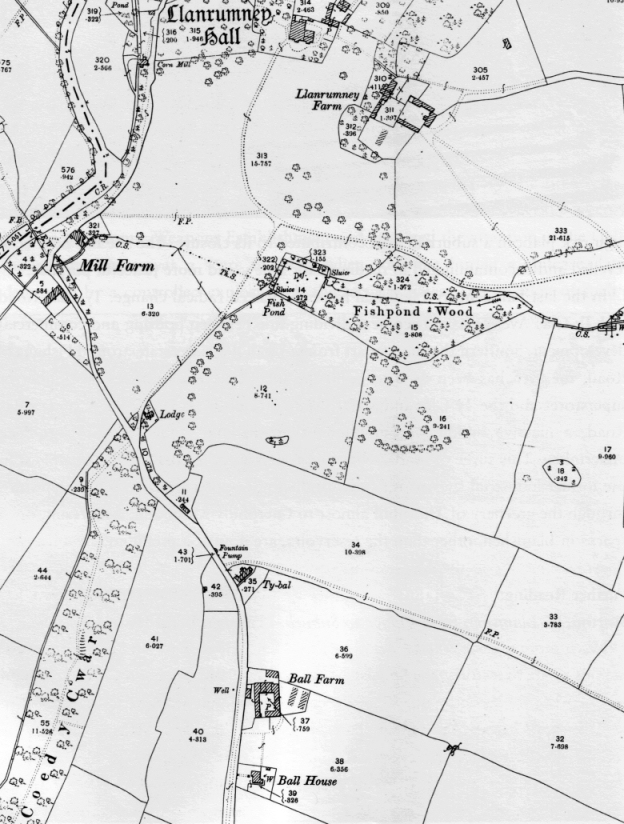
Source: OS
Llanrumney Hall and Captain Morgan
The Hall and its 700 acre estate was passed to the Kemys family of Cefn Mably in the mid 16th Century, after the dissolution of the Monasteries by Henry VIII.
William Kemys left the property to his daughter, who married Thomas Morgan. Sir Henry Morgan, a close relation of Thomas, was a notorious and successful privateer, and considered by many to be one of the most dangerous pirates that lurked in the Spanish Main in the 17th century.
It is said that Sir Henry was born in Llanrumney Hall in 1635, but there is little evidence to confirm this. Henry's reputation as a fearsome pirate was used in 1944 to create a new brand of Rum.
The Captain Morgan Rum Company still produces the drink to this day. The Morgan coat-of-arms, dated 1587, can be seen above a fireplace at the hall, where five generations of the family lived, and many of them are buried in the Llanrumney Chapel of St Mellons Church.
The Hall was rebuilt in 1852 and refurbished at around 1900 when at the time it was owned by C.C. Williams, who became the last lord of the manor at Llanrumney Hall.
Known as Squire Williams, he was a typical country gentleman and a much-respected local figure. Until 1951, apart from Ball Farm and Mill Farm, the Hall was the only building of significance in the area.
Housing Developments
In that year Llanrumney Hall and its parkland were sold by compulsory purchase to Cardiff City Council. Squire Williams could have remained at the hall but, saddened at the loss of his lands, he moved to the Vale of Glamorgan.
A few years later Llanrumney Hall was sold to Hancocks Brewery and was converted into a public house.
The land was used to provide new homes and, while most of them were council houses, there were private properties as well, some of which still stand at the top of the hill in Ball Road.
Education
Two single sex secondary modern schools were built at the foot of Llanrumney Hill, and opened their doors to pupils for the first time in 1958.
They expanded as numbers grew, and the buildings were enlarged and finally combined in the early seventies to form a comprehensive school of 1,800 pupils.
The Eastern Leisure Centre opened in 1982, and has good links with local schools and community groups.
Rumney Recreation Ground
In recent years, the local authority had been considering plans to close the Llanrumney and Rumney High Schools, as well as the Leisure Centre, and construct a brand new secondary school with new leisure facilities.
The plans were vehemently opposed by Llanrumney and Rumney's residents, arguing that ancient greenland would be lost forever, and an action group was set up in 2007 to oppose the planned developments.
The decision to merge the schools and build on the recreation ground was made in February 2010. However; in a last ditch attempt to save the grounds, a petition signed by 8,000 people objecting to the plans was submitted.
This public outpouring of anger was the nail in the coffin of the original plan to build on the grounds, and the authority dropped the scheme in favour of the existing Rumney School site.
A large granite stone, bearing an inscription to the communities of east Cardiff who campaigned to save Rumney Recreation Ground, was unveiled on the ground in 2012.[REF]
PAGE UPDATE HISTORY
01 April 2024 (Content and coding updates)
01 December 2014 (Coding updates)
July 2009 (Page Created)