THE HISTORY OF CARDIFF'S SUBURBS
LLANISHEN
Incorporating Ty Glas and Thornhill
CONTENTS
Tap or click to open / closeSt. Isan
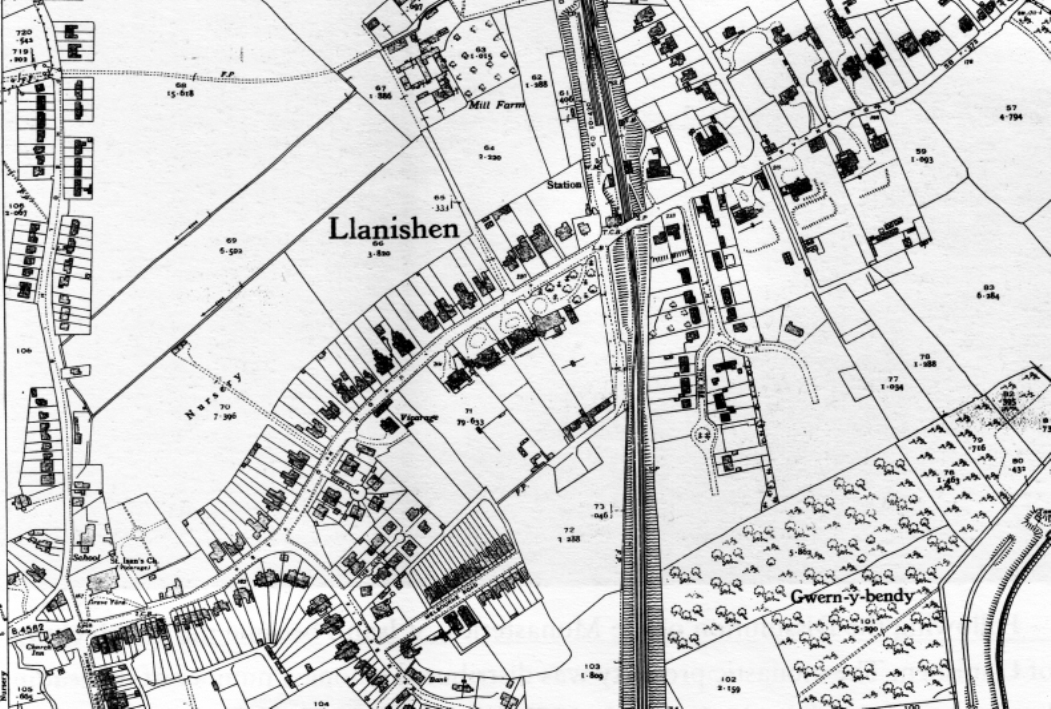
Source: OS
Llanishen is named after St Isan who founded a Christian community in the sixth century. St. Isan and a fellow monk, St. Edeyrn were given the task of spreading the faith and establishing places of worship.
The first location chosen by the two monks was Llanishen, and it is understood that St. Edeyrn also established Llanedeyrn Church nearby.
After the Norman Conquest, the Abbey of Keynsham was awarded land in Llanishen, increasing it's inventory of its many estates in and around Cardiff.
The Normans built the present St Isan’s Church, which probably dates from the middle of the 12th century.
Following Henry VIII's Suppression of the Monasteries in the 16th century, St Isan’s became the parish church of Llanishen. In 1872, the church was enlarged and most of its stained glass dates from this time.
The Lewis Family
During the Suppression, the monastic properties were distributed among a number of high status and powerful families, including the Kemys' and Lewises.
The original home of the Lewises was near the church at Llanishen House (now fallen to decay) and for more than two centuries, the Lewis family conducted their affairs from here.
They later moved to a mansion built in the 18th century on Thornhill known as 'New House' which is now a hotel.
Development of the Village
In the early 1870's, navvies from Llanishen formed part of the workforce that constructed the Rhymney Railway link from Caerphilly to the docks in Cardiff.
The work included tunneling through Caerphilly Mountain, and as was common at the time, there were frequent accidents with many workers were killed. They now lie buried in Llanishen churchyard.
Many of the farms at that time bore names that are still familiar in the district, such as Fidlas and Ty-Glas. There were only a few roads leading to the village, which steered you to the village pub, the blacksmith’s and a school.
This school was built on land donated by the Marquis of Bute in 1867, and remained in use for nearly a century before it was converted into the church hall for community use.
At the rear of what was Fidlas Farm, are Llanishen and Lisvane reservoirs. Constructed in 1884, the Llanishen reservoir was completed just in time to see Cardiff through a severe drought which occurred a few years later.
Just before the first World War, large properties were being constructed in Fidlas Road and Station Road. Originally, the gardens were grand in design, however as the 20th Century progressed, many roads were widened to accommodated increasing volumes of traffic, and the gardens were reduced in size.
One property, Bridge Cottage managed to avoid losing it's garden. Surrounded by trees near the railway viaduct, the cottage is reputed to be 300 years old.
Royal Ordnance Factory
Llanishen became a suburb of Cardiff in 1922, and within 20 years, urbanisation took hold in a major way.
In 1939, the Royal Ordnance Factory was constructed on Caerphilly Road and within a year, was producing anti-aircraft and anti-tank guns.
After World War Two, the factory became an Atomic Weapons Establishment. It continued to make nuclear warheads until 1997 when the factory was closed down.
The site has since been cleared and decontaminated, and is now a mixed office and housing development.
Parc Ty Glas - Inland Revenue and Housing
By 1968, the Inland Revenue offices in Ty-Glas Road were under construction.
Although there were concerns at the time about the imposing structures, and its proximity to local housing, the offices have since served the community well by providing employment opportunities over the years.
There were two phases of building, with the 16-storey Phase 2 tower being the tallest building in northern Cardiff. Another development, Parc Ty Glas, is home to the offices of S4C and the National Eisteddfod of Wales.
Since the 1970's, Llanishen has experienced radical change. Ty-Glas Road and Ty-Glas Avenue have become hubs of housing and commercial development, while superstores and business parks sprang up on the few former industrial sites.
Thornhill
Thornhill Crematorium was opened in 1953 and occupies a 40-acre site shared with Thornhill Cemetery.
There are two chapels, The Wenallt and the Briwnant Chapel with Gardens of Remembrance for the scattering of cremated remains.
Although the Local Authority had originally planned for small villages seperated by wide greeen spaces, the extensive housing developments in the late 1980s meant that this planning option was no longer viable.
Thornhill is served by a small shopping centre on Excalibur Drive and lies on the outskirts of the M4 motorway.
The proposed Junction 31, which has been on hold since 1991, may eventually be constructed to provide a direct link to Thornhill.
This will depend on whether residents in the area wish to have the relatively peaceful suburb disturbed by a substantial increase in traffic, in addition to the problems associated with the sourcing of the £71 million required to build the link.
Fight to Save the Reservoirs
In 2002, Western Power Distribution acquired Llanishen and Lisvane reservoirs from Welsh Water, and submitted plans to fill in and build a housing estate on them.
The plans were rejected after many residents came together to form the Reservoir Action Group (RAG), who campaigned against WPD's proposal.
In 2008, WPD attempted to resubmit the plans, however; they were rejected by the Welsh Assembly Government. In 2009, CADW listed Llanishen reservoir as a site of historic interest, but this did not stop WPD beginning the process of draining the reservoir in February 2010.
Then just half full, and with Lisvane reservoir vanishing quickly in the driest spring since 1976 - the fight to save these exceptionally important reservoirs, both in terms of biodiversity and historical value, took the next step with the issue being raised in the House of Commons.
On 20th January 2016, Celsa granted a 999 year lease for the reservoir site to Dŵr Cymru / Welsh Water. Llanishen reservoir was refilled, and public access to the site was created for water sports and walking in a beautiful, peaceful setting.
PAGE UPDATE HISTORY
01 April 2024 (Content and coding updates)
01 December 2014 (Coding updates)
July 2009 (Page Created)